Explore
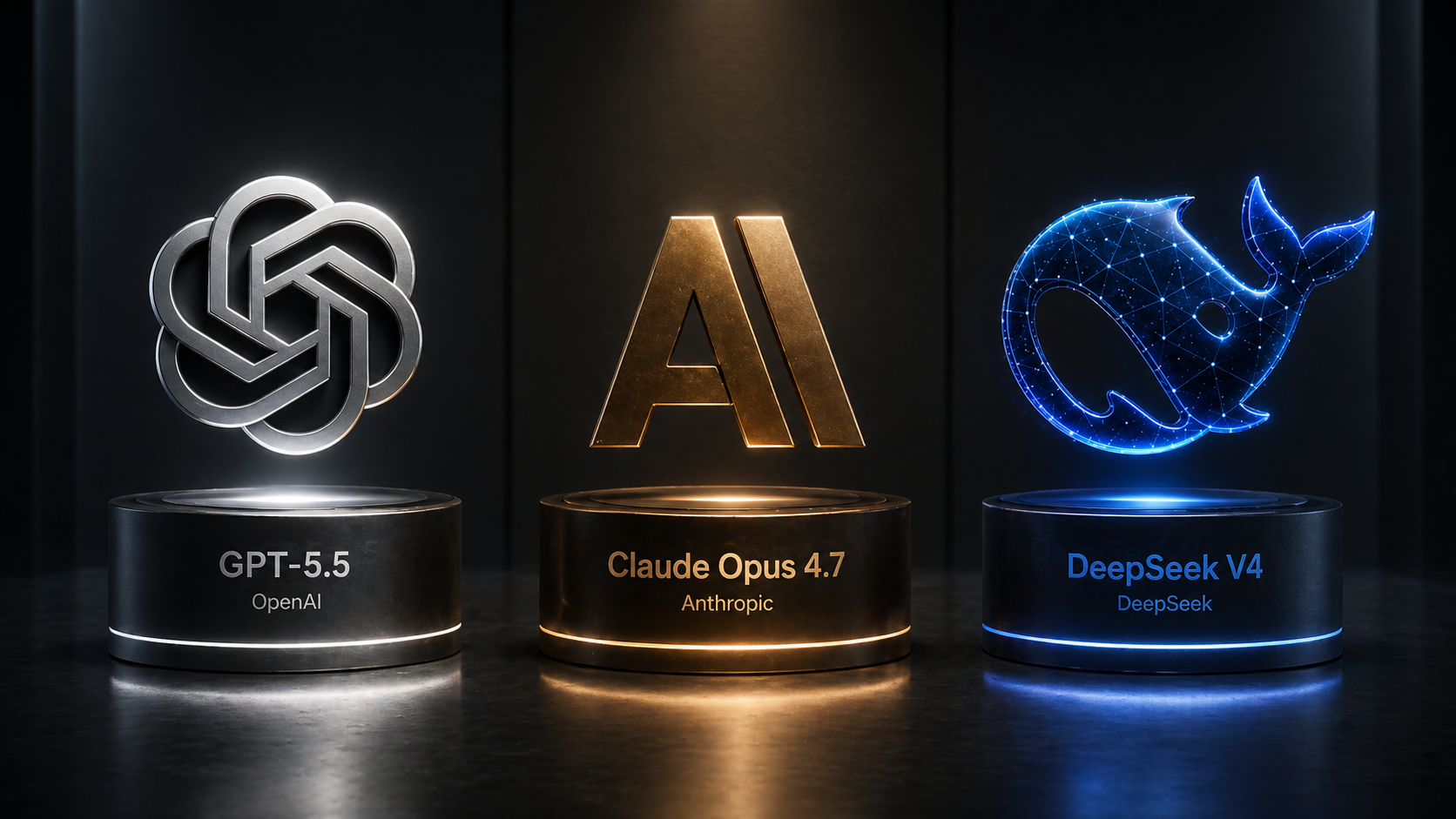
GPT-5.5 vs DeepSeek V4 vs Claude Opus 4.7 Comparison
Three frontier models landed within 8 days. None is the clear winner. We dissect benchmarks, hidden costs, and real-world use cases so you can pick the right model — and avoid the wrong one.
Toosio Team
The Story Right Now
On April 23, 2026, OpenAI released GPT-5.5. The next day, DeepSeek pushed V4-Pro and V4-Flash. Six days earlier, Anthropic shipped Claude Opus 4.7. Three frontier models. Eight days. And still — nobody can agree on which one actually wins.
This wasn’t just another incremental update spiral. Each model represents a completely different philosophy. Claude Opus 4.7 obsessed over coding precision and safety. GPT-5.5 bet everything on agentic versatility. DeepSeek V4 leaned hard into cost demolition and open-source freedom. The result? A fragmented landscape where the “best” model depends entirely on what you’re doing — and how much you’re paying.
Here’s the price shock: GPT-5.5 doubled its API cost to $5/$30 per million input/output tokens. DeepSeek V4-Pro? Just $1.74/$3.48 — roughly one-seventh the price. Claude Opus 4.7 held steady at $5/$25 but packs a new tokenizer that quietly burns up to 35% more tokens on the same text. So that “steady” price is a mirage. Real costs shifted under everyone’s feet.
And then there’s the hallucination problem. New data from The Decoder shows GPT-5.5 hallucinates at an 86% rate — versus 36% for Claude Opus 4.7. On BullshitBench, Claude pushes back on nonsense; GPT-5.5 takes the bait 55% of the time. For anyone doing factual, analytical work, that’s terrifying.
OpenAI president Greg Brockman called GPT-5.5 “a big step towards more agentic and intuitive computing.” That might be true. But the ground has shifted. The question isn’t which model wins the benchmark pageant. It’s which one you should actually trust with your work. Let’s break it down.
What’s Actually Changing (And Why Most People Miss It)
The obvious story is the benchmarks. The real story is reliability per dollar. Benchmarks measure peak performance in sterile conditions. They don’t measure what happens when a model has to plan a 30-step task, check its own work, and not lose the plot halfway. That’s where the divergence gets ugly — and fascinating.
Take Claude Opus 4.7. It leads SWE-bench Verified at 64.3%, a solid 5.7 points ahead of GPT-5.5. That’s pure coding precision. But on Terminal-Bench 2.0 — which tests sustained computer-use and tool orchestration — Claude scores 69.4% to GPT-5.5’s 82.7%. That’s a 13.3-point gap. Why? Because GPT-5.5 was built from the ground up to be agentic. It’s natively omnimodal, retrained from scratch after GPT-4.5. Claude is a coding sniper; GPT-5.5 is a task tank. Different jobs, different tools.
Most people also missed the tokenizer trap. Claude Opus 4.7 uses a new tokenizer that can consume up to 35% more tokens on the same text. So that $5/$25 pricing? For existing workloads, you’re effectively paying $6.75/$33.75. Meanwhile, GPT-5.5 uses about 40% fewer tokens than its predecessor. The headline price doubled, but heavy Codex users might only see a 20% net cost increase. DeepSeek V4? It’s so cheap it almost doesn’t matter — but its hosted API routes through Chinese infrastructure, which is a non-starter for regulated US industries.
The other under-discussed shift is tool orchestration. Anthropic built Claude Opus 4.7 to own the MCP (Model Context Protocol) standard. On MCP Atlas, it leads GPT-5.5 79.1% to 75.3%. If your team has bet heavily on MCP for multi-tool workflows, Claude isn’t just better — it’s the only rational choice. For everyone else, that gap is meaningless.
And then there’s DeepSeek V4, completely open under MIT license. You can self-host it. That changes the game for data sovereignty. But V4 is still in Preview — no stability guarantees. And at 1.6 trillion parameters, self-hosting the Pro version demands serious cluster capacity. Most teams will still use the API. So the open-source dream? It’s real but expensive in hardware, not just licensing.

Claude AI (Anthropic)
Pay-as-you-goAnthropic's reasoning-focused AI assistant for complex coding, analysis, and multi-step workflows.
The Numbers Don’t Lie: Market Data & Key Drivers
We’ve aggregated the most comprehensive benchmark comparison you’ll find anywhere. Every number sourced from original evaluations — no marketing fluff. Here’s the raw state of play:
- Coding (SWE-bench Verified): Claude Opus 4.7 leads at 64.3% vs GPT-5.5’s 58.6%. DeepSeek V4-Pro ranges 55–80% depending on config. Claude is the go-to for production PRs.
- Agentic Terminal Tasks (Terminal-Bench 2.0): GPT-5.5 dominates at 82.7%. Claude Opus 4.7: 69.4%. DeepSeek V4-Pro-Max: 67.9%. If you’re automating dev environments, GPT-5.5 is miles ahead.
- PhD Reasoning (GPQA Diamond): Gemini 3.1 Pro squeaks past at 94.3%, Claude Opus 4.7 at 94.2%, GPT-5.5 at 93.6%. DeepSeek V4-Pro-Max at 90.1%. For cutting-edge research reasoning, the gap between open and closed is clearest here.
- Long Context Recall (MRCR v2 at 1M tokens): GPT-5.5 more than doubled its predecessor — from 36.6% to 74.0%. DeepSeek V4 and Claude also handle 1M tokens, but GPT-5.5’s retrieval accuracy is now best-in-class.
- Abstract Reasoning (ARC-AGI-2): GPT-5.5 scores 85.0%, an 11.7-point leap over GPT-5.4. That’s the largest single-generation improvement from any model family on this benchmark.
- Competition Math (LiveCodeBench): DeepSeek V4-Pro Max tops the group at 93.5 in thinking mode, with a blended score of 85. It’s the new king of competitive programming.
- Web Research (BrowseComp): GPT-5.5 at 84.4%, DeepSeek V4-Pro-Max at 83.4%, Claude Opus 4.7 at 79.3%. Very tight, but GPT-5.5’s browse abilities edge out.
But raw benchmarks only tell half the story. Reliability metrics paint a different picture. Claude Opus 4.7 has the lowest hallucination rate at 36%, per The Decoder. GPT-5.5? A shocking 86%. On BullshitBench, Claude pushes back on nonsensical questions most often; GPT-5.5 plays along 55% of the time. If your output has to be factually trustworthy, Claude is the only safe bet. For creative brainstorming where you’ll verify later? GPT-5.5’s fluidity might be worth the risk.
Price, of course, is the other massive driver. DeepSeek V4-Pro costs $1.74/$3.48 per million tokens — undercutting GPT-5.5 by roughly 7x and Claude by 10x. For high-volume, cost-sensitive workloads, that’s not a comparison; it’s a slaughter. The catch: you get what you pay for in long-horizon agency and tool reliability. And the infrastructure questions remain.
Impact Matrix: Who Gets Hit and How Hard
| Industry / Role | Impact Level | What Changes | What To Do Now |
|---|---|---|---|
| Software Developers | Medium | Coding quality vs agentic loops diverge. No one model covers all. | Use Claude for complex PRs; GPT-5.5 for multi-step test generation. |
| Startups | High | API costs can kill runway. DeepSeek V4-Pro offers 7-10x savings. | Default to V4-Flash, escalate to Pro for tough reasoning; budget cautiously for preview risks. |
| Enterprise AI Teams | High | MCP standard becomes critical. Claude leads tool orchestration. | Build hybrid pipelines: Claude for MCP, GPT-5.5 for agentic research, DeepSeek for batch jobs. |
| Researchers | Medium | Hallucination rates matter more than raw IQ. Claude’s 36% vs GPT-5.5’s 86%. | Use Claude for literature synthesis; verify GPT-5.5 outputs with retrieval tools. |
| Regulated Industries (Fintech, Health) | Critical | Data residency and self-hosting requirements rule out DeepSeek API. | Self-host DeepSeek V4-Pro or stay with Claude/GPT-5.5 via US-based cloud endpoints. |
| Data-Heavy SMEs | Low-Medium | High volume token processing favors cheapest option. | Route 70% to V4-Flash; use GPT-5.5 for complex analysis. |
| Investors | Medium | Battle shifts from model weights to orchestration middleware. Winners own the routing layer. | Watch companies building AI gateways, not just model startups. |
The pattern is clear: no single model will dominate. Teams that lock into one vendor are setting themselves up for either overspending or underperforming. The smart money is on orchestration layers that route tasks to the right model based on the job — coding to Claude, agentic to GPT-5.5, high-volume to DeepSeek.
Regulated industries face the toughest call. Self-hosting DeepSeek V4-Pro satisfies data sovereignty but demands significant GPU clusters. Meanwhile, DeepSeek’s hosted API routes data through Chinese servers — a hard stop for US healthcare, finance, or defense. For them, the choice is either self-hosting or sticking with Claude’s hallucination-proof reliability via AWS/GCP US regions. The irony? The most cost-effective model may actually cost more in compliance engineering.
Real People, Real Results: Case Studies
DevFabrik: GPT-5.5’s Agentic Promise, Then the Hallucination Sucker Punch
DevFabrik, a 12-person dev tools startup in Austin, switched their CI/CD test generation pipeline from GPT-5.4 to GPT-5.5 on April 24. Within 48 hours, they saw a 30% reduction in raw token usage and a 40% faster test cycle because GPT-5.5’s agentic loop could plan multi-file test suites in one go. “It felt like we’d hired a senior QA engineer,” said CTO Mia Keller. But by day 5, they noticed unit tests that were beautifully structured — but entirely wrong. The model was inventing API contracts that didn’t exist, because it couldn’t admit it didn’t know the codebase. The hallucination rate on internal platform code spiked to over 80% when the context window exceeded 500K tokens. They had to roll back to a hybrid: GPT-5.5 for planning, Claude Opus 4.7 for verification. Net result: better overall accuracy, but a painful 2-week rewrite of their test harness.
FinWhisper: Claude Opus 4.7’s Verbose Brilliance Burns Cash
FinWhisper, a Series B compliance startup, migrated their financial report generation module from Opus 4.6 to 4.7 in early May. The output quality was stunning — nuanced, well-cited summaries that passed regulatory review with fewer human corrections. But within the first month, their API bill jumped 45%. The culprit: Opus 4.7’s new tokenizer plus its tendency to produce 7,500–8,800 character responses, double the length of their previous outputs. The reports were better, but they were paying for extra verbosity that didn’t add regulatory value. They fixed it by post-processing with a smaller model to summarize the summaries, but CFO Raj Patel admitted, “We didn’t expect to need a cost-cutting layer on top of a premium model.”
DataLake AI: DeepSeek V4’s Self-Hosted Savior — With Strings Attached
DataLake AI runs a government-facing analytics platform that can’t send data outside EU borders. When DeepSeek V4-Pro dropped under MIT license, they jumped to self-host it on an on-prem cluster of 32 H100s. The results: per-token inference costs dropped to effectively zero (just electricity and maintenance), and they could process overnight batch jobs that previously cost $20K/month on GPT-4.5. But two issues emerged: for tasks requiring more than 25 sequential tool calls, V4-Pro’s accuracy degraded noticeably compared to their old Claude pipeline. They now use DeepSeek for 80% of jobs but maintain a small Claude Opus 4.7 instance for complex audit trails. Total cost savings: 60%, but with the overhead of managing two models.
The common thread? No single model handles everything well. The teams that succeeded — after some bruises — built routing layers and accepted the operational complexity of a multi-model world.
What Happens Next: 2026-2027 Predictions
- By Q1 2027, model routing middleware will be a $2 billion market. The fragmentation is too expensive to manage manually. Startups like Portkey and Helicone are already raising heavily. I expect a major cloud provider (likely AWS) to launch a native routing service by re:Invent 2026.
- OpenAI cuts GPT-5.5 pricing 30% before December 2026. DeepSeek’s 7x cost advantage is untenable for maintaining developer share. Sam Altman won’t admit it publicly, but enterprise negotiation decks already include DeepSeek as a bargaining chip. The price will come down, or volume will evaporate.
- DeepSeek will exit Preview and announce a US-fed server option by Q2 2027 — but at a 3-5x premium. Data sovereignty demands will force the issue. Don’t expect the $1.74 price to hold for US-hosted inference; infrastructure costs alone make that impossible. But even at $5-8/M input, it’ll undercut OpenAI and Anthropic while offering self-hosting escape hatches.
- Claude Opus 4.7 remains the coding champion through 2027, but agentic adoption will plateau. Anthropic’s safety-first DNA means they’ll resist the kind of autonomous loops that GPT-5.5 embraces. For teams building fully autonomous coding agents, Claude’s caution feels like handcuffs. They’ll keep the high-value coding work but lose the agentic frontier.
- Contrarian take: Benchmark scores will stop mattering by mid-2026. The real world doesn’t run on SWE-bench. It runs on cost-per-accurate-task. We’ll see a shift to “task-level” metrics: what percentage of end-to-end jobs are completed correctly, on time, and under budget. Models will be judged by business outcomes, not leaderboards. The teams who build internal evaluation suites now will dominate next year.
Your move before Q4 2026? Stop evaluating models in isolation. Set up a three-model sandbox with the same test suite: GPT-5.5, Claude Opus 4.7, and DeepSeek V4-Pro. Measure cost, accuracy, and reliability per task type. Then build a routing proxy with fallback logic. The engineering investment now will pay for itself tenfold when the next wave of models drops in 2027.
FAQ: What People Are Searching Right Now
Is DeepSeek V4 safe to use for enterprise work?
It depends on your data residency and regulatory requirements. DeepSeek’s hosted API routes through Chinese infrastructure, which is a dealbreaker for US government, healthcare, and financial services. However, because it’s MIT licensed, you can self-host it on your own hardware and avoid that entirely. The model is still in Preview, so no stability guarantees — but if you need open weights for sovereignty, it’s your best option. Just don’t send sensitive data through the hosted API.
Does GPT-5.5 actually justify the doubled API price?
Only if you’re using its agentic capabilities heavily. GPT-5.5 consumes about 40% fewer tokens than GPT-5.4, so many users will see a net cost increase closer to 20%, not 100%. If you need long-context retrieval, computer-use automation, or complex multi-step research, the improved performance might justify it. But for routine chat or simple Q&A, you’re overpaying — DeepSeek V4 does that at one-seventh the cost. The real gouge is on output tokens at $30/M, so watch your verbosity settings.
What’s different between Claude Opus 4.7 and 4.6 — is it worth upgrading?
Opus 4.7 brings task budgets, high-res image support up to 3.75MP, and improved MCP tool orchestration. It also leads SWE-bench Verified at 64.3% and Arena Elo at 1503, meaning real users prefer it. The catch: a new tokenizer can burn 35% more tokens. If you’re doing heavy multi-step coding or MCP workflows, upgrade immediately. If you’re using Claude for summarization or light chat, you might see a cost spike with marginal benefit. Enable adaptive thinking explicitly — it’s off by default.
Can I run DeepSeek V4 locally?
Yes, but with caveats. V4-Pro is available under MIT license with full weights on Hugging Face. However, it’s a 1.6 trillion parameter model — you’ll need a serious cluster to run it at production latency. V4-Flash is smaller and more practical. It runs on both Nvidia Blackwell and Huawei Ascend clusters, so you have hardware flexibility. For personal experimentation, you can run quantized versions on a single high-end GPU, but don’t expect blazing speed.
Which model hallucinates the least?
Claude Opus 4.7, by a landslide. It hallucinates at 36% versus GPT-5.5’s 86% and DeepSeek’s roughly 60%. Claude also tops the BullshitBench, pushing back on nonsensical questions instead of fabricating answers. For any work where factual accuracy is non-negotiable — legal, medical, financial — Claude is the only rational choice. GPT-5.5’s fluency is seductive, but it confidently invents facts more than any other frontier model.
The Bottom Line: What You Should Actually Do
Stop looking for The One Model. It doesn’t exist. The week of April 16-24, 2026 proved that the AI frontier has splintered into specialist tools.
If you’re a developer: Route coding tasks to Claude Opus 4.7 for PRs and complex refactors. Use GPT-5.5 for agentic test generation and terminal automation. Put DeepSeek V4-Flash on bulk, repetitive API calls to crush your bill. Yes, it’s more to manage — but your 40-60% cost savings will buy you a lot of engineering time.
If you’re a business owner: Don’t bother with benchmarks. Run a bake-off on your actual workload. Track cost-per-accurate-task, not tokens. Negotiate volume pricing with at least two vendors. And if your data can’t leave your country, self-host DeepSeek V4-Pro — it’s not perfect, but it’s the only frontier model that’ll work in your cage.
If you’re an investor: The model layer is a bloodbath. The real value is shifting to the routing and orchestration middleware. Fund the companies that make it easy to switch between models, not the ones betting on a single model’s dominance. And keep an eye on DeepSeek’s next move — if they crack US hosting, the pricing pressure will be nuclear.
The AI race isn’t about who builds the smartest model. It’s about who best matches the right tool to the right job at the right price. Start doing that now, or get steamrolled by someone who does.
More Tools to Explore
Other highly-rated AI tools in this category.